The Death Card: Transformation, Reversed, Love
A skeleton in armor rides a white horse, and on the horizon, between two towers, the sun is rising. Death is the thirteenth major arcana and the most misread card of the deck. It almost never announces a death. It announces a transformation: something in your life has finished its cycle, and refusing to let it end is the only real danger here.
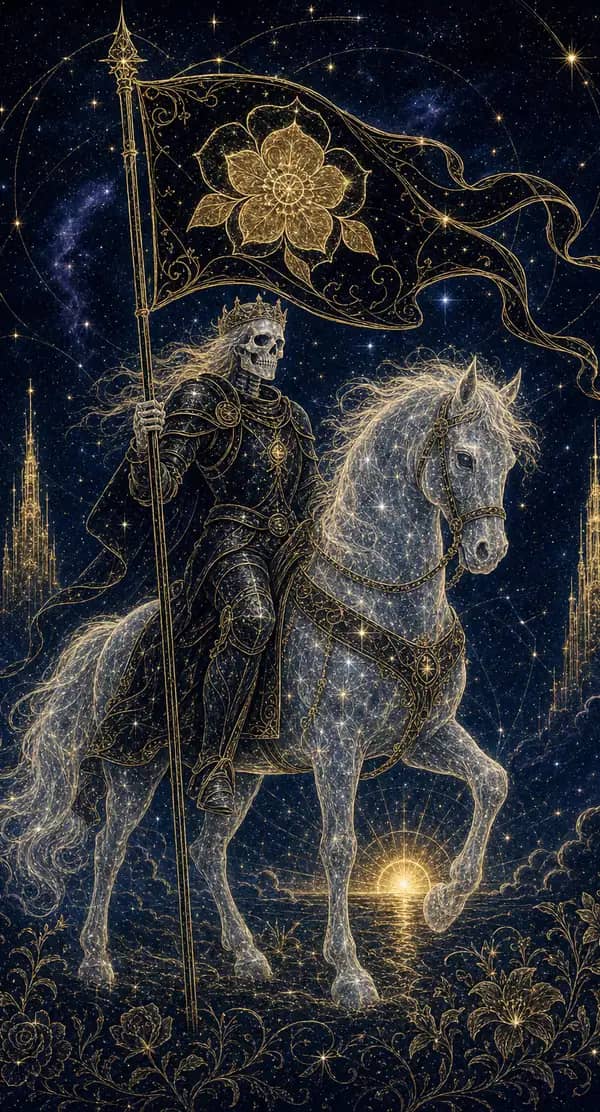
Death meaning (upright)
Upright, Death names the ending that makes the next chapter possible. A phase of your life, a role, a belief, a way of loving or working has completed itself. The card does not ask your permission; the transformation is already underway. What it offers is the correct posture: release rather than cling. On the card, a bishop, a maiden and a child face the rider, and only the child looks without terror. That is the invitation, to meet the change with eyes that expect a beginning.
Death is a card of precision. It does not sweep everything; it takes exactly what is finished. In a reading, look at the question you asked: the arcana points to the specific structure that has stopped being alive, an identity outgrown, a situation maintained by habit, a hope kept on life support. The energy consumed by holding the dead thing upright is the energy your next life is waiting for.
The sun rising between the towers is the card's true center. Every tradition that handles this arcana seriously reads it the same way: transformation, transition, renewal. What Death promises is not loss but metamorphosis, the caterpillar's ending seen from the butterfly's side. When this card appears, the most fertile question is not what you are losing. It is what has been trying to begin in you, and could not, as long as the old form occupied its place.
Death reversed
Reversed, Death describes the transformation resisted. The cycle has ended and you are still holding the door shut: prolonging a situation past its life, repeating a role that no longer fits, negotiating with an ending as if it were optional. The card's energy does not disappear when resisted. It accumulates, and what could have been a clean transition hardens into stagnation, fatigue, the peculiar heaviness of a life waiting for itself.
This reversal is often gentler than it looks: it appears when you are almost ready. The fear is not of the ending, which part of you has already accepted, but of the unknown that follows it. Reversed, Death invites one honest inventory: what are you keeping alive artificially, and what would become possible within weeks if you let it complete? The card returns upright the moment the grip loosens.
Death in love
In love, Death rarely announces the end of the couple. It announces the end of a version of the couple: a dynamic that has run its course, a silence that must finish, an old wound whose reign is over. Relationships that pass through this card and accept the transformation come out deeper, because what survives is what was genuinely alive. For singles, Death often marks the true end of an old story, the release that finally makes room for a new one.
Reversed in a love reading, the card points at the bond kept in suspension: neither fully lived nor fully released, an attachment maintained because ending it would demand a self you have not yet dared to become. The counsel is the same in both orientations: let what is finished finish. Love that follows a real ending is not diminished by it. It is founded on it.
What to ask when Death appears
Death rewards questions of completion: what in my life has finished without my admitting it? What am I maintaining out of habit or fear? What would begin if I let this end? It answers poorly to questions that seek reassurance that nothing will change, because its entire message is that the change is the gift.
In a quantum reading, this card's placement turns a frightening symbol into a map. Your ten cards are drawn by a quantum generator at the exact second of your question, and Death's position localizes the transformation: in the past, the ending has already happened and asks to be acknowledged; in the present, the transition is now; in the outcome, the reading promises renewal as the destination. The surrounding cards name what ends, and what the rising sun brings.
Frequently asked questions
Does the Death tarot card mean someone will die?
No. In practice, this arcana speaks of symbolic endings: a cycle, a role, a situation or a belief completing itself so something new can begin. Readers across every serious tradition treat it as the card of transformation. Its image, the sun rising between two towers, holds its real message.
What does Death mean reversed?
Transformation resisted: a finished situation kept artificially alive, a change postponed out of fear of the unknown. The resistance converts a clean transition into stagnation. The card rights itself the moment you loosen the grip and let the ending complete.
Is Death a bad card in a love reading?
It is a demanding card, not a cruel one. It usually marks the end of a dynamic within the couple rather than the end of the couple, and for singles the true release of an old story. What crosses this card and remains standing is what was genuinely alive in the bond.
Why is Death numbered thirteen?
Thirteen follows twelve, the number of the completed cycle, and begins the next one. The card sits at exactly that hinge in the major arcana: after the Hanged Man's suspension, Death performs the passage. Its number marks not misfortune but the necessary step between one order and the one that follows.