Eight of Swords: Restriction, Reversed, Love
A woman stands bound and blindfolded, hemmed in by eight swords planted in the ground. Yet the swords do not form a full cage, the binding is loose, and the ground ahead is open. The Eight of Swords is the card of the prison that is mostly in the mind, and the door that was never truly locked.
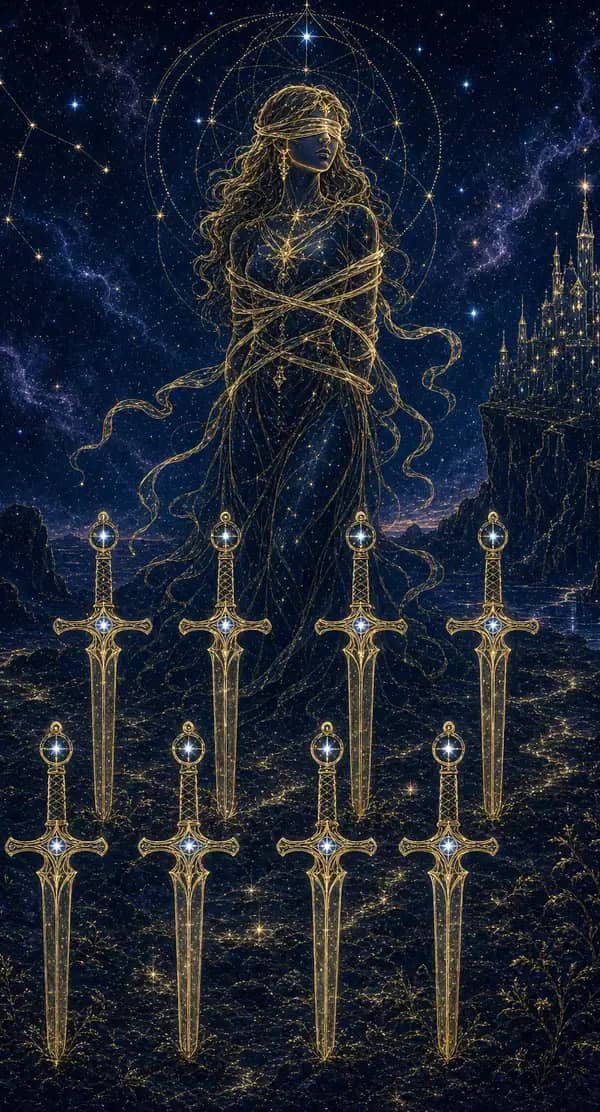
Eight of Swords meaning (upright)
Upright, the Eight of Swords names the experience of feeling trapped. Options seem to have vanished, every direction looks blocked, and a heavy powerlessness settles over the situation. The card takes that feeling seriously; it is real and it hurts. But the image holds a second truth on purpose: the swords leave a gap, the bonds are loose, and the blindfold is the reason the way out cannot be seen. The trap is built more of perception than of walls.
In a reading, this arcana points to restriction that is at least partly self-imposed. Fear has narrowed the field of vision until only the walls remain visible. A belief, a story you tell about your own limits, a worst-case scenario rehearsed so often it feels like fact: these are the swords. The Eight does not deny that circumstances constrain you. It insists that they constrain you less than you currently believe, and that the first move is to take off the blindfold and look.
The card also speaks of paralysis by fear. When it appears, the danger is not the situation itself but the freeze it produces, the way dread convinces you that acting will only make things worse. The Eight of Swords answers that with a quiet challenge: test one bond. Take one small step toward the gap. Almost always, the prisoner discovers that the ropes give more easily than expected, and that movement, however slight, dissolves the spell that stillness was casting.
Eight of Swords reversed
Reversed, the Eight of Swords is a card of release. The blindfold comes off, the bonds fall away, and the exit that was there all along becomes visible. This position often marks the moment a person realizes the trap was survivable, even leaveable, and reclaims a sense of their own power. It is the relief that follows a long stretch of feeling stuck, the clarity that arrives when fear finally loosens its grip.
There is a harder version of this reversal. Sometimes it shows the restriction deepening before it breaks, the fear tightening, the sense of no way out at its most acute. Read this not as a verdict but as a threshold. The reversed Eight, even at its heaviest, is a card in motion; the very intensity of the trap is often the pressure that finally forces the step out of it. What feels like the worst moment is frequently the last one before release.
Eight of Swords in love
In love, the Eight of Swords marks a relationship, or a single life, that feels stuck without an obvious cause. It often describes staying in a situation out of fear rather than desire: fear of being alone, fear of the unknown, fear that leaving would be worse than enduring. The card gently points out that the cage has a gap, and that the belief there is no other option is itself the tightest of the bonds.
For someone single, it can name the story that love is not available to you, a conviction so practiced it has started arranging the evidence. Reversed in a love reading, the arcana is hopeful: the fear lifts, the false limits dissolve, and choices that felt impossible come back into view. This card almost never says you are trapped. It says you feel trapped, and that the difference is exactly where your freedom begins.
What to ask when Eight of Swords appears
The Eight of Swords rewards questions that test the walls: which of my limits are real and which are stories? What one small step could I take toward the gap? What am I not seeing because fear has narrowed my view? It answers poorly to questions that ask only how bad things are, because its entire purpose is to move you from the size of the trap to the location of the exit.
In a quantum reading, this card's placement shows where the blindfold sits. Your ten cards are drawn by a quantum generator at the exact second of your question, so the draw belongs to the precise moment you felt cornered. In the past, the Eight marks a restriction already loosening; in the present, a fear asking to be tested; in the outcome, it promises release once the perceived walls are examined. The surrounding cards reveal which bond to try first.
Frequently asked questions
What does the Eight of Swords mean?
It names the feeling of being trapped, of options gone and every direction blocked. The image contradicts that on purpose: the swords leave a gap, the bonds are loose, and the blindfold is why the exit cannot be seen. The card says the restriction is largely one of perception and fear, not of true walls.
What does the Eight of Swords mean reversed?
Usually release: the blindfold comes off, the exit appears, and a sense of power returns after a long stretch of feeling stuck. In its harder form it shows the trap tightening just before it breaks, which is often the pressure that finally forces the step out.
What does the Eight of Swords mean in love?
It often describes staying in a relationship, or a single life, out of fear rather than desire, believing there is no other option. That belief is itself the tightest bond. Reversed, the fear lifts and choices that felt impossible return into view.
Is the Eight of Swords about being powerless?
It captures the feeling of powerlessness precisely, but it disputes the fact of it. The card's whole teaching is that the prison is mostly mental and the door was never fully locked. Testing one bond, taking one small step, tends to dissolve the paralysis that stillness was feeding.