Ten of Swords: Painful Ending, Reversed, Love
A figure lies still beneath ten swords, and it looks like the worst card in the deck. Then you notice the sky: black on one side, and on the other, a band of gold where the sun is rising. The Ten of Swords is the card of rock bottom, and rock bottom, by definition, is the place where the falling stops.
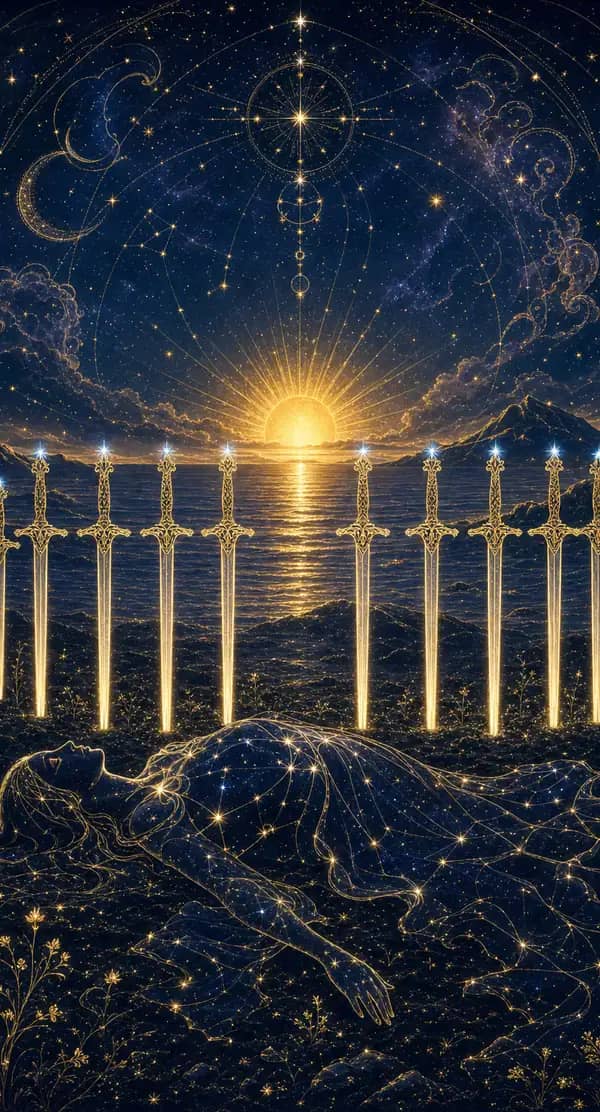
Ten of Swords meaning (upright)
Upright, the Ten of Swords names a painful ending, the kind that feels total. Something has finished in the hardest way: a betrayal, a collapse, a defeat that leaves you flat on the ground. The card does not soften this. It is the deck acknowledging that some endings are not gentle transitions but brutal ones, and that pretending otherwise helps no one. If it has appeared, the pain is real and the card meets it honestly.
But the excess in the image is deliberate. Ten swords is more than any wound requires; the picture is almost theatrical, and that is the point. The Ten of Swords marks the bottom of the fall, the moment when the situation cannot get worse because it has already reached its floor. There is a strange relief buried here. When you have hit the ground, the direction that remains is up, and the sun rising on the horizon is the card keeping its promise even in its darkest frame.
In a reading, this arcana often signals a clean break, an ending so complete that it forecloses the endless negotiation. What the Five of Swords started in half-measures, the Ten finishes absolutely. There is no ambiguity left to manage, no door ajar to keep watching. That finality, painful as it is, is also a kind of mercy: it frees the energy you were spending on a situation that was never going to recover, and hands it back to you for the dawn.
Ten of Swords reversed
Reversed, the Ten of Swords is a card of recovery and rising. The worst has passed, the ground is behind you, and the slow work of standing up begins. This position often marks survival made conscious, the moment you realize you endured the thing you feared would end you, and that you are still here. It is the dawn breaking fully, the return of strength after a season on the floor.
There is a harder version of the reversal. Sometimes it shows a person refusing to let the ending be over, replaying the betrayal, keeping the wound open, dramatizing a pain that is asking to be released. Here the card counsels a decision: to stop pulling the swords out and putting them back. The ending happened; the recovery is a choice. The reversed Ten, in this form, is the card asking you to let the sun you can already see finish rising.
Ten of Swords in love
In love, the Ten of Swords speaks of an ending that hurt deeply, a betrayal, a breakup that felt like collapse, the definitive close of a relationship you had hoped would last. It does not pretend the pain is small. What it insists on is that this is the bottom, not an endless descent, and that the finality, however cruel, has ended a suffering that a slower ending would have prolonged. The clean break is the beginning of healing.
For someone single carrying an old heartbreak, the card can name the wound that finally stops bleeding. Reversed in a love reading, it is genuinely hopeful: recovery underway, the capacity to trust returning, a person rising from a loss they were sure would keep them down. The card's whole arc bends toward dawn. It shows love at its lowest precisely so it can show you that even there, the light on the horizon is already on its way.
What to ask when Ten of Swords appears
The Ten of Swords rewards questions of completion and recovery: what has truly ended, and can I let it be over? What is the first thing I do now that the falling has stopped? What strength does surviving this reveal? It answers poorly to questions that ask how to revive what has died, because its entire lesson is that the ending is the floor, and the floor is where the climb begins.
In a quantum reading, this card's placement turns a bleak image into an honest map. Your ten cards are drawn by a quantum generator at the exact second of your question, so the draw belongs to the precise moment the ending was live in you. In the past, the Ten marks a collapse already survived; in the present, a bottom being reached; in the outcome, it promises the dawn that follows rock bottom. The surrounding cards reveal what has ended and what the rising sun will bring.
Frequently asked questions
Is the Ten of Swords the worst card in the tarot?
It looks like it, and that is deliberate. It names a painful ending, betrayal, or rock bottom without softening the blow. But the excess of ten swords marks the very bottom of the fall, the point where things cannot worsen, and the sun rising in the image is the card's honest promise that dawn follows.
What does the Ten of Swords mean reversed?
Usually recovery and rising: the worst has passed and strength is returning after a season on the floor. In a harder form it shows someone refusing to let an ending be over, keeping the wound open, and it counsels the decision to stop reopening it and let healing proceed.
What does the Ten of Swords mean in love?
It speaks of a deep ending: a betrayal, a breakup that felt like collapse, the definitive close of a relationship. It does not minimize the pain, but it frames the finality as mercy, an end to a suffering a slower close would have dragged out. Reversed, it marks healing and the return of trust.
Does the Ten of Swords mean things will get better?
Yes, that is its buried message. Rock bottom is by definition the place where the falling stops, and the only direction left is up. The rising sun on the horizon is not decoration; it is the card telling you that this ending, however brutal, is the ground from which recovery begins.